How to set a yearly reading goal
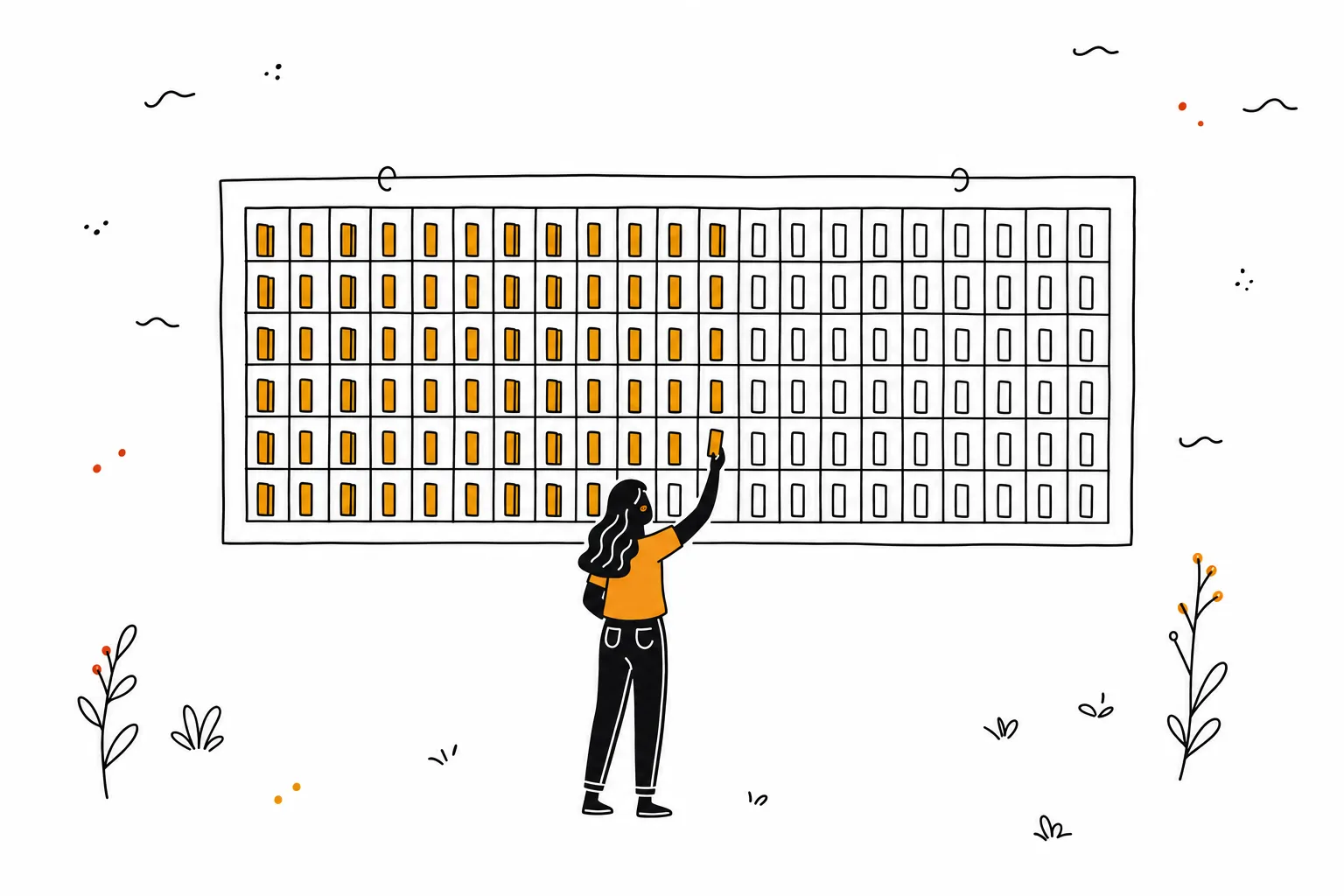
Base the number on last year rather than on ambition. Count the books you finished in the last twelve months, add around twenty per cent, and use that as your target. A goal built from your real pace survives February; one built from the reading life you wish you had is usually abandoned by then.
Work out your real reading pace
You need two numbers: how many books you finished last year, and how many minutes a day you read on an ordinary day. Most readers overestimate the second by a factor of two, so use a week of honest observation rather than memory.
Thirty minutes a day at an average pace is roughly thirty pages, which is about one three-hundred-page book a fortnight, or twenty-five books a year. Fifteen minutes a day is around twelve. Those two figures cover most people, and neither requires a reading retreat to hit.
If you have no history at all, start at twelve. One book a month is a real commitment for a first year and leaves you room to raise the target in June rather than quietly missing a larger one all year.
Choose a unit that matches how you read
Books are the standard unit and the least fair one. A goal counted in books quietly pushes you towards short books in December, and it makes a reader working through Dostoevsky look lazy next to someone reading novellas.
Pages fix that distortion. Twelve thousand pages a year is about the same work as forty average novels, and it treats a seven-hundred-page book as what it is. The trade-off is that page counts vary between editions, so the number is approximate.
Pick one and stay with it for the year. Switching units mid-year makes the comparison to last year meaningless, which was the point of measuring.
Break the year into checkpoints
A single annual number gives you no signal until it is too late to act on. Divide it by twelve and check monthly, or by four and check quarterly if monthly feels like homework.
Thirty books a year is two and a half a month. By the end of March you should be near eight. If you are at four, you can still fix it in April; if you notice in November, you cannot.
- Count what you finished in the last twelve months.
- Add roughly twenty per cent and round to a sensible number.
- Divide by twelve to get a monthly target, and write it down.
- Check in at the end of each month against that target, not against the annual figure.
- Adjust once, in July. Raising a goal you are beating is as useful as lowering one you are not.
Handle the month you fall behind
You will have a bad month. Work, illness or a book you cannot get through will cost you three weeks, and the honest response is to look at what caused it rather than to read two novellas to catch up.
If a single book stalled you, put it down. An abandoned book that was blocking your reading for a month costs far more than it looks like on a shelf. If life caused it, absorb the loss and carry on at your normal pace: a goal missed by three books is a good reading year, and a goal abandoned in March is not.
Decide what the goal is for
A number is a tool for building a habit. If yours starts pushing you towards books you do not want to read, or away from a long book you have been looking forward to, it has stopped doing its job.
Some readers keep a second, softer goal alongside the count: one classic, one book in translation, one from the shelf of things bought and never opened. That gives the year a shape the number alone cannot.
Questions
Do audiobooks count towards a reading goal?
That is your call, and the only wrong answer is changing it halfway through the year. If you count them, count them consistently, and note the format so a future comparison with this year still means something.
What happens to a goal I miss?
Nothing, beyond the information it gives you. A year at twenty-two books against a target of thirty tells you your real pace is twenty-two, which is exactly the number you need to set next year properly.
Keep reading
How to track your reading progress
Log the page you stopped on, and you get pace, a finish estimate, and an early warning when a book stalls.
GuideHow to keep track of books you've read
Notebook, spreadsheet, or app: what each option costs in effort, and how to start a log that survives past February.
GuideHow to organize your TBR list
Split it into a short shelf you read from and a long list you shop from, then purge on a schedule.